

Once you have thoroughly studied intonation and word connections, you can begin to address the sounds of English. The three most important vowels are æ, ä, and  .
.
This last symbol, called the schwa, is represented with an upside down e, and is the most common sound in the English language. These are the vowels found in cat, caught and cut.
The three most distinctive consonants are R, the American middle T, and the Th sound.
The R i
s a consonant, but it acts more like a vowel, because the tip of the tongue doesn't touch anywhere in the mouth. The middle T is what makes a word like meeting sound like meeding. As the most commonly used word in English is the word the, the Th is very important. Here are some very high-frequency TH words: the, these, those, they, them, there, they're, their, this, that and then. If these and those are pronounced with a D instead of a TH, it sounds like dese and dose, which is considered lower class in America.
The American R
The American R is like a vowel because it does not touch anywhere in the mouth. In Korean, Japanese, Spanish, Italian, Greek and many other languages, the R is a consonant because it touches behind the teeth. The American R is produced deep in the throat. Like the French R and the German R, the American R is in the throat, but unlike those two consonant sounds, it doesn't touch. Let's contrast two similar sounds: ä and r. Hold your hand out in front of you, with your palm up, like you are holding a tray on it. Slightly drop your hand down, and say ah, like you want the doctor to see your throat. Now, curl your fingers up slightly, and say r. Your tongue should feel in about the same position as your hand.
æ
Let's start with the æ sound. Although it's not a common sound, æ is very distinctive to the ear, and is typically American. In the practice paragraph vowel chart, this sound occurs 5 times. As its phonetic symbol indicates, æ is a combination of ä + e. To pronounce it, drop your jaw down as if you were going to say ä; then from that position, try to say eh. The f inal sound is not two separate vowels, but rather the end result of the combination. It is very close to the sound that a goat makes: ma-a-a-a!
If you find yourself getting too nasal with æ, pinch your nose as you say it. Go to the practice paragraph and find the 5 æ sounds, including æu as in down or out.
ä
The ä sound is a more common sound than æ; you will find 10 such sounds in the practice paragraph. To pronounce ä, relax your tongue and drop your jaw as far down as it will go. As a matter of fact, put your hand under your chin and say mä, pä, tä, sä. Your hand should be pushed down by your jaw as it opens. Remember, it's the sound that you make when the doctor wants to see your throat.
uh
Last is the schwa, the most common sound in American English. When you work on the practice paragraph, depending on how fast you speak, how smoothly you make liaisons, how strong your into nation is, how much you relax your sounds, you will find from 50 to 75 schwas. Spelling doesn't help identify it, because it can appear as any one of the vowels, or a combination of them. It is a neutral vowel sound, uh. It is usually in an unstressed syllable, though it can be stressed as well.
Whenever you find a vowel that can be crossed out and its absence wouldn't change the pronunciation of the word, you have probably found a schwa: photography f'tägr'fee (the two apostrophes show the location of the neutral vowel sounds).
Because it is so common, however, the wrong pronunciation of this one little sound can leave your speech strongly accented, even if you Americanize everything else.
Remember, some dictionaries use two different written characters, the upside down e & ^ for the neutral uh sound, but for simplicity, we are only going to use the first one.
Silent or Neutral?
A schwa is neutral, but it is not silent. By comparison, the silent E at the end of a word is a signal for pronunciation, but it is not pronounced itself: code is kod. The E tells you to say an o. If you leave the E off, you have cod, käd. The schwa, on the other hand, is neutral, but it is an actual sound, uh. For example, you could also write photography as phuh-tah-gruh-fee.
The schwa is a neutral sound, (no distinctive characteristics), but it is the most common sound in the English language. To make the uh sound, put your hand on your diaphragm and push until a grunt escapes. Don't move your jaw, tongue or lips, just allow the sound to flow past your vocal cords. It should sound like uh, not ah.
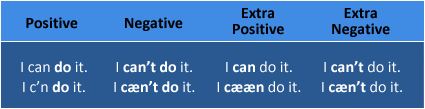
Once you master the two sounds æ and uh, you will have an easier time pronouncing 'can' and 'can't'. In a sentence, the simple positive 'can' sound like k'n. The simple negative 'can't' sounds like kæn(t).
The American T
The American T is influenced very strongly by intonation and its position in a word or phrase. It can be a little tricky if you try to base your pronunciation on spelling alone.
There are, however, 4 basic rules: T is T, T is D, T is Silent,T is Held.
1 Top of the Staircase T is T
If the T is at the beginning of a word (or the top of the staircase), it is a strong, clear T sound.
In the beginning of a word: table, take, tomorrow, teach, ten, turn Thomas tried two times.
With a stressed T and ST, TS, TR, CT, LT and sometimes NT combinations: They control the contents.
In the past tense, D sounds like T, after an unvoiced consonant sound — f, k, p, s, ch, sh, th (but not T).
picked pikt, hoped houpt, raced rast, watched wächt, washed wäsht
It took Tim ten times to try the telephone.
2 Middle of the Staircase T is D
If the T is in the middle of the word, intonation changes the sound to a soft D.
Letter sounds like ledder.
Water, daughter, bought a, caught a, lot of, got a, later, meeting, better
Practice these sentences:
What a good idea. w'd' güdäi deey'
Put it in a bottle. pü di di n' bäd'l
Get a better water heater. gedda bedder wäder heeder
Put all the data in the computer. püdall the dayd' in the k'mpyuder
Patty ought to write a better letter. pædy äd' ride a bedder ledder
3 T is Silent
T and N are so close in the mouth that the t can disappear.
interview innerview
international innernational
advantage ædvæn'j
percentage percen'j
If the T is at the end of a word, you almost don't hear it at all.
put, what, lot, set, hot, sit, shot, brought.
That's quite right, isn't it?
4 Bottom of the Staircase T is Held
With -tain, -tten and some TN combinations, the T is held. The "held T" is, strictly speaking, not really a T at all. Remember, t and n are very close in the mouth. If you have n immediately after t, you don't pop the t—the tongue is in the t position, but your release the air for the n not the t. Make sure you don't put a schwa before the n. An important point to remember is that you need a sharp upward sliding intonation up to the "held T," then a quick drop for the N.
Written, certain, forgotten, sentence
He's forgotten the carton of satin mittens.
She's certain that he has written it.
Martin has gotten a kitten.
The American L
The American L has two different pronunciations in English (of course, otherwise it would be too easy!). In the beginning or middle of a word, the tongue tip touches just behind the teeth — on those hard ridges. In this position, the L shouldn't give you much trouble. The difficulty begins when the L is at the end of a word. Because the letter L has a shorter, sharper pronunciation in other languages, this will carry over into English, where the whole word will just sound too short. At the end of a word, the L is especially noticeable if it is either missing (Chinese) or too short (Spanish). You need to put a little schwa sound before the final L. If you want to say the word ball, bäl, it will sound too short if you don't say bä-uhl. You may even need to add a tiny schwa at the end to finish off the L, bä-uh-luh.
One way to avoid the pronunciation difficulty of a final L, such as in call, is to make a liaison when the next word begins with a vowel. For example, if you want to say I have to call on my friend, let the liaison do your work for you; say, I have to kä-län my friend.
Tee Aitch
The most common word in the English language is THE, so after the schwa, th would be the sound you would hear most often, which is why it is so important to master it. (th also exists in English, Greek and Castillian Spanish.) Besides 'the,' there are several other very common words that start with a voiced th:I and E
These two sounds probably give you a lot of trouble. One reason for this is that most languages don't make a distinction here. Another reason is that there are four ways of saying these two sounds, depending what the final consonant is.